Sunday, 24 April 2016

and here a pause...


With a house move just completed and a new website needed (I no longer live in Colva and now do more than make artist's books) there will be a bit of a pause in content updates. Nothing imminent; best just to have a cup of tea for now. So for now, here's a photograph I took of balloons over Bagan in Myanmar in December 2015.

Monday, 21 September 2015

Hulls

 
I have long wanted to do something with the dried seed heads of the Welsh poppy (Meconopsis cambrica), which has proliferated in our garden walls and paving. Sometimes they weather to look like tiny wizened hands, but here I have utilised their resemblance to the hulls of boats, or dugouts. The backing, from which they set out on their journey, is a section of an old wooden measuring rule. The work is, of course, extremely fragile, as strong only as the dried stalks, the symbolism apt for the current (and horribly recurrent) news which inspired it, of desperate people setting to sea. The words on the top of the piece (Forþon me hatran sind / Dryhtnes dreamas / þonne þis deade lif / læne on londe) are taken from the Anglo-Saxon poem, The Seafarer, and though written in an entirely different context, they are fitting. There are many translations of the words; my own version is: 'Dearer to me my Maker's blessings than this fleeting mortal life'.

Triptych


Recently I was looking for old books with a quantity of blank, or nearly blank, pages to print over. To this end I bought, in the Honesty Bookshop in Hay, a copy of 'Celebrated and Historical Speeches', printed in London in 1933. An unexpected bonus came on the front flyleaf, with an anonymous inscription from (presumably) the book's sometime owner. It read: 'The war settled nothing, achieved nothing. & all but wrecked civilisation. Never should we again allow the stupidity of Emperors, & rulers, or the futility of politicians rush us (sic) into the madness of another such conflict.' Wise words, made all the more poignant by the fact that they had bled through and made a negative impression, a sort of radioactive afterimage, in white on the following blank page. I sourced another copy of the book and made a triptych from three of its boards, with the emendation and its afterimage making up the side panels and the book's half-title the centre. The remainder of the book, with its thousands upon thousands of words, from rulers, monarchs, statesmen and politicians, was removed.

Thursday, 17 September 2015

Moulding Plane: The Plough

A second moulding plane marked with a changing pattern of stars, this time those comprising the asterism of The Plough (aka The Great Wain or Wagon, Charles's Wain, or The Big Dipper) - Dubhe, Merak, Phecda, Megrez, Alioth, Mizar (a double star with Alcor) and Alkaid. Again, the blue stars show how it looked to humans 50 millennia ago, the white stars how it looks now, and the red stars how it will look in 100 millennia.

Moulding Plane: Cassiopeia


A moulding plane marked with the changing pattern of the stars (as seen from Earth) that comprise the constellation of Cassiopeia. The blue stars show it looked from our perspective 50 millennia ago, the white stars how it looks now, and the red stars how it will look in 100 millennia, with list of the star's traditional names - Shedir, Caph, Tsih , Ruchbah and Segin - on the rear.

Monday, 14 September 2015

43 Simenon (si ou non)


August 2015
double-sewn booklet
16 pages
180mm x 214mm


The content of Simenon (Simenon si ou non) comprises the openings or endings of six novels – two Maigrets and four romans durs – by Georges Simenon. The openings have been rewritten into endings, and the endings have likewise been turned into openings. Barring a few minor changes necessitated by grammatical sense the words are identical, just re-ordered; they are paired by number throughout, raising the puzzle of which is which, with the identities of both originals and imposters revealed at the end. The booklet is sewn at both sides (this was the origin for the booklet in fact as I was looking for a subject suitable for such a treatment) with the pages interleaved. I know the French title is gramatically shaky (‘You’re not going to call it that, are you? Si!’) but that’s what it has been since the booklet’s inception; the name was too good not to make use of in such a way.

writers on phonograph cylinders cabinet


August 2015

What was once a spice cabinet is now the housing for all six of the cylinders in the 'writers on phonograph cylinders' series - Algernon Blackwood, Hans Henny Jahnn, Robert Walser, Franz Kafka, Hermann Hesse and Arthur Machen, details of which can be found throughout the blog. The bottom drawers of the cabinet are filled with fireweed silks and dried marigolds respectively, their contents the same as those found in the cylinders for Robert Walser and Hermann Hesse. There is also another cabinet I have made to house all six cylinders, reconstituted from an old oak writing slope, now repaired, shelved and felt-lined.

writers on phonograph cylinders: Arthur Machen


July 2015

This sixth and last cylinder pays homage to the Welsh writer Arthur Machen (1863-1947), author of, among others, The Inmost Light (1894), The Three Imposters (1895), Ornaments in Jade (1895), The White People (1899), The Bowmen (1914), The Great Return (1915) and The Terror (1917).

Born in Caerleon in Gwent, but living and working for the bulk of his creative life in London, Machen was a writer of the borderlands, the literal ones of the Welsh Marches to which he returned time and again in his fiction but also the liminal worlds of the uncanny as they manifest in the everyday. His was an ability, as Iain Sinclair puts it in his 2103 essay, Our Unknown Everywhere, 'to recognise holy hills behind a sprawl of suburbs'. Holy hills and shadowy strangeness; his half-hidden worlds of pungent darkness that he conjured in his works required a similar treatment, hence the cylinder is lined with an old dark pelt of uncertain provenance. Works referenced on the cylnder include The Great God Pan (1894), A Fragment of Life (1906) and The London Adventure (1924).

writers on phonograph cylinders: Hermann Hesse


May 2015

This fifth entry in the phonograph series pays homage to the German-speaking Swiss poet, novelist, and painter, Hermann Hesse (1877-1962), the author of, amongst others, Knulp (1915), Strange News from Another Star (1919), Narziss and Goldmund (1930) and The Glass Bead Game (1943). The main lettering on the cylinder has been transformed from 'Edison Blue Amberol Record' to 'Amberol Pure-Tone Record', a nod towards Hesse's key essay written in 1914, after the outbreak of the First World War, O Freunde, nicht diese Töne!, in which he decried the unthinking lurch to nationalism and called for people to remember their common European heritage. Other works referenced on the cylinder include Siddhartha (1922), Steppenwolf (1927) and Wandering (1920), with a passage from that beautiful collection's Mountain Pass ('But I smile, and not only with my mouth. I smile with my soul, with my eyes, with my whole skin, and I offer these countrysides, whose fragrances drift up to me, different senses than those I had before, more delicate, more silent, more finely honed, better practised, and more grateful…') printed on the side. As with all of the cylinders, this one contains something appropriate to the writer inside, in this case dried marigolds. As an important plant of offering, festivities and worship in both western and eastern religions, they seemed the perfect plant to pay homage to a writer who sought and promoted spiritual truth and understanding through his words.

Tuesday, 23 June 2015

six translations of The Top by Kafka: 2015 edition


June 2015
sewn booklet
20 pages
128mm x 164mm

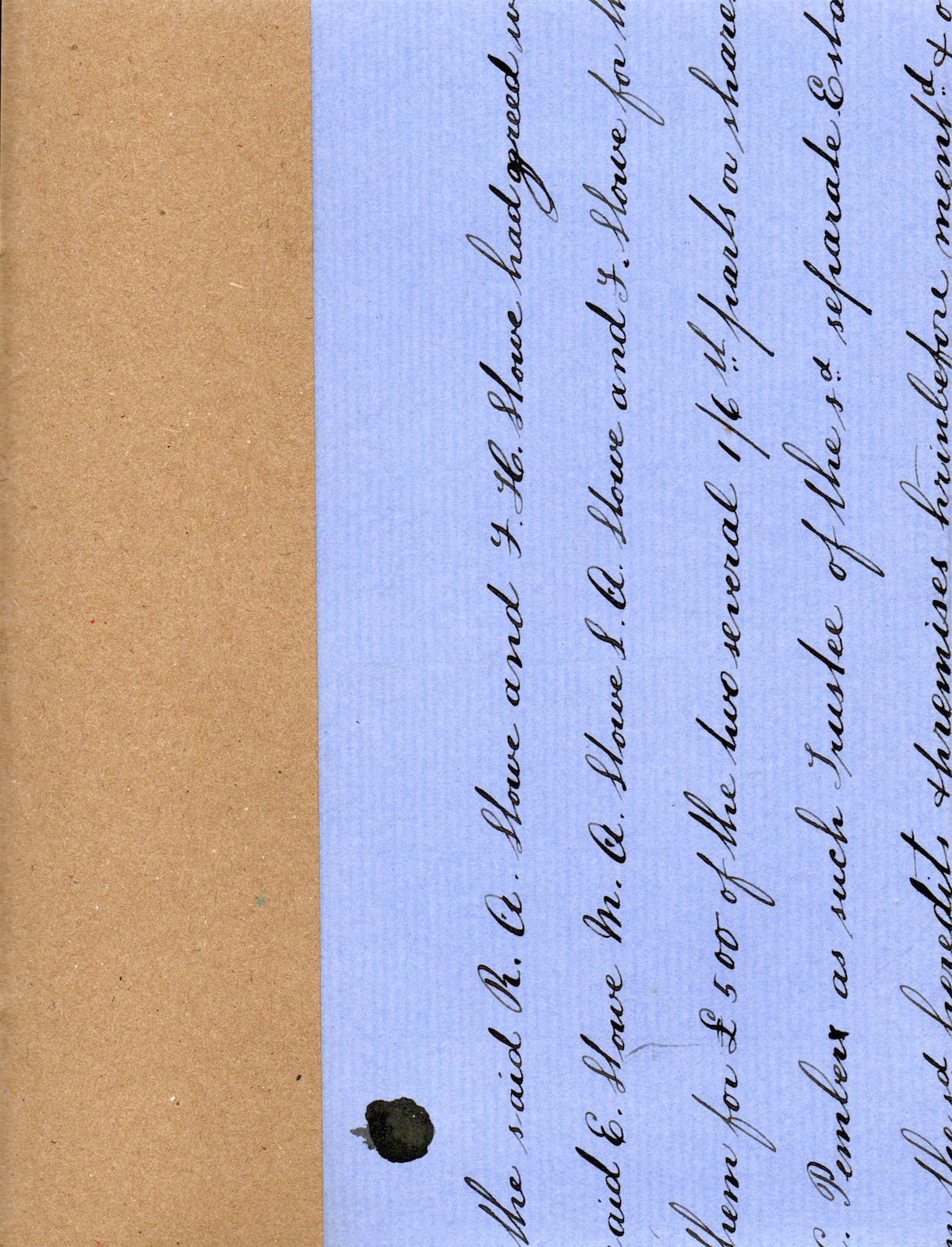
A re-set edition of a booklet that I originally wrote in 2002 - Six Translations of The Top by Kafka. The content of the booklet comprises six transliterations, in English, of an English translation of Kafka's short story, The Top (c. 1917-23). After the original story, the transliterations take, respectively, the following forms: same syllable count; a retelling through dictionary definitions; a retelling using the Oulipian standby of n+7 (replacing the story's nouns with the noun 7 words after it in a chosen dictionary); an anagram of the original; a version using the same syntax and punctuation, and lastly a version using the same syntax. The covers use the pages from some wonderful 1880s legal blue paper I found, whose lines of convoluted legalese seem just right for the content.

66 gates


March 2015
Card with CD
148mm x 148mm

I knew there were a lot of gates on the Offa's Dyke path between Kington and Knighton, my main memory of a September walk - along with finding a decent haul of both Beefsteak Fungus and Hen of the Woods, both cooked up and enjoyed in the following days - being the clanging of gates; what I didn't realise was that are 66 of them (probably more now) in the 12 1/2 miles. I walked the route again (Knighton to Kington) on 18th March this year (2015) and took my recorder with me, capturing both the opening of the gate, the pause and the subsequent clang, letting the reverberations die down until background noise took over. Listening afterwards it's interesting how the background traffic noise near Knighton gives way to skylarks in the hills above and then sounds of lambing as Kington nears. I hadn't realised either that the sound of gates - all so individual - could be quite so funny.

Wednesday, 3 June 2015

exhibition in Freshford


My cylinders and a number of bookworks appropriate to the theme of the exhibition - 'Artists who use Found Objects' - are going to be on display in Freshford, near Bath, from June 6th-June 14th (I think I come under 'Curiosities'.) Open 11-6 daily - come along if you are nearby!

Tuesday, 31 March 2015

42 three stories from the journals of Stanton Hamer


February 2015
sewn booklet with wrappers
148mm x 210mm
28 pages

A collection of three stories transposed from the travel journals of one Stanton Hamer, unearthed from a box of unsorted papers won at auction. The tales – untitled in the original but which I have named …and They Danced, Sleep and Ribbon Bows – are set in 1950s France, where Hamer evidently travelled independently for some years.

(The stories are in fact fictional, as are the journals, as, for that matter, is Stanton Hamer, but the images – which inspired the book in the first place – are real, albeit scanned at a very high resolution from the 14mm x 12mm original transparencies found on a collection of French sterescope cards.)

Wednesday, 4 March 2015

cine-series 1-12


February 2015
140mm x 120mm
sewn booklets

Having spent the best part of twelve years writing and podcasting on a diverse range of film for MovieMail, Vertigo, Artesian, Second Run, the BFI and Borderlines Film Festival, I wanted to put together a valedictory series to all that, so I have collected together a few longer pieces written during that time – some previously published in somewhat altered form, others unpublished, nearly all with an element of poetry in their appreciation – and made a small 'cine-series' of 12 booklets. The films range in date from the silent era to the 21st century and are all linked by the single fact that they have touched me deeply in some way – deeply enough for their narratives to interweave with that of my own life, either directly or obliquely. The size and cover design tips the hat to those 1960s-70s 'Studio Vista' books on directors and film movements. The twelve titles in the series are Mother and Son (Alexandr Sokurov, 1997), Into Great Silence (Philip Gröning, 2005), Love (Károly Makk, 1971), Szindbád (Zoltan Huszárik, 1971), Alice in the Cities (Wim Wenders, 1974), Rapture by Tearlight: The Silent Cinema of Frank Borzage, Shame (Ingmar Bergman, 1968), L'Argent (Marcel L'Herbier, 1928), Palms (Artur Aristakisyan, 1994), Cave of Forgotten Dreams (Werner Herzog, 2010), Patches of Prepared Darkness: Val Lewton's Cat People, and City Girl (FW Murnau, 1930). The cover image shown here is from Palms.

Tuesday, 4 November 2014

41 they would still lie plainly visible


October 2014
142mm x 208mm
sewn booklet with wrappers
24 pages

In A Book of Luminous Things: An International Anthology of Poetry (1996), editor Czeslaw Milosz included a short poem entitled The Day We Die, which he calls a song from the ‘Southern Bushmen’. The only credit – given in the ‘Permissions’ section at the back of the book – goes to Arthur Markowitz, who is named – erroneously – as the ‘translator’. All of which does its author and its real translator, without whom these words and thoughts would be entirely lost to us, a great injustice. For this is not an anonymous song. (To give an idea how inaccurate this is as a description, imagine taking the words from one small part of a chorus as it appears in one Greek tragedy from a known dramatist and calling it a ‘song of the southern European’.) We know who told it to whom, on what day and where. There are even photographs of the storyteller and his translator. The story – of which ‘The Day we Die’ is but one part and which was given the title ‘The Relations of Wind, Moon and Cloud to Human Beings after Death’ by Lucy Lloyd – was told by the !nussa !e Bushman Dia!kwain, in a |xam dialect which was transcribed by Lucy Lloyd on 5th August, 1875 in Cape Town. It appears on pages 5147-5158 in her notebook, Bushman (D.H.) Pp.5079-5168 1875 V.—15 – one of the 131 of her notebooks, containing transcriptions of stories in |xam and !kun languages, which can be seen online at the remarkable Digital Bleek and Lloyd collection. This booklet gives a brief history of the text and how it has changed since 1875, and looks at how the abridged version that appears in the anthology distorts the original and continues the history of marginalisation and worse that has been the Bushmen's lot. It also attempts to restore Dia!kwain and Lucy Lloyd’s names to their rightful place as originators of the text. The title – and the writing on the booklet’s wrapper – is taken from the third page of Lloyd’s original transcription of the story.

Wednesday, 13 August 2014

writers on cylinders: Franz Kafka


This fourth entry in the phonograph series features Franz Kafka. The original top label featured the artist Fred Heltmann, who has here became 'Fred Haltmann' - the perfect person to sing 'I Waited at the Gate (A Lament)', which sounds just about right for the writer of Before the Law. The 186 words of licensing legalese written on the top of the original label - from 'No license whatever is granted to anyone to use this patented record for making duplicates nor for any other purpose except the reproduction of sound upon an Edison phonograph by means of an Edison reproducer' to 'any violation hereof or of the license agreements of our licensees is an infringement of our patent rights for which every person concerned therein is liable' - are astonishing in that they take up fully half of the label but are still printed so small that they are illegible without magnification. With a nod towards the travails of Kafka's various characters trapped in impossible bureaucratic neverlands, I've changed the wording around to make it both slightly less comprehensible and slightly more nonsensical than it is already. I have however made it a little more legible. The original phonograph type was ' Edison Blue Amberol Record,' whose title I have changed to 'The New "Paterfamilias" Record' which seems fitting. Kafka had one or two problems with his father in his lifetime, but he is the daddy now.

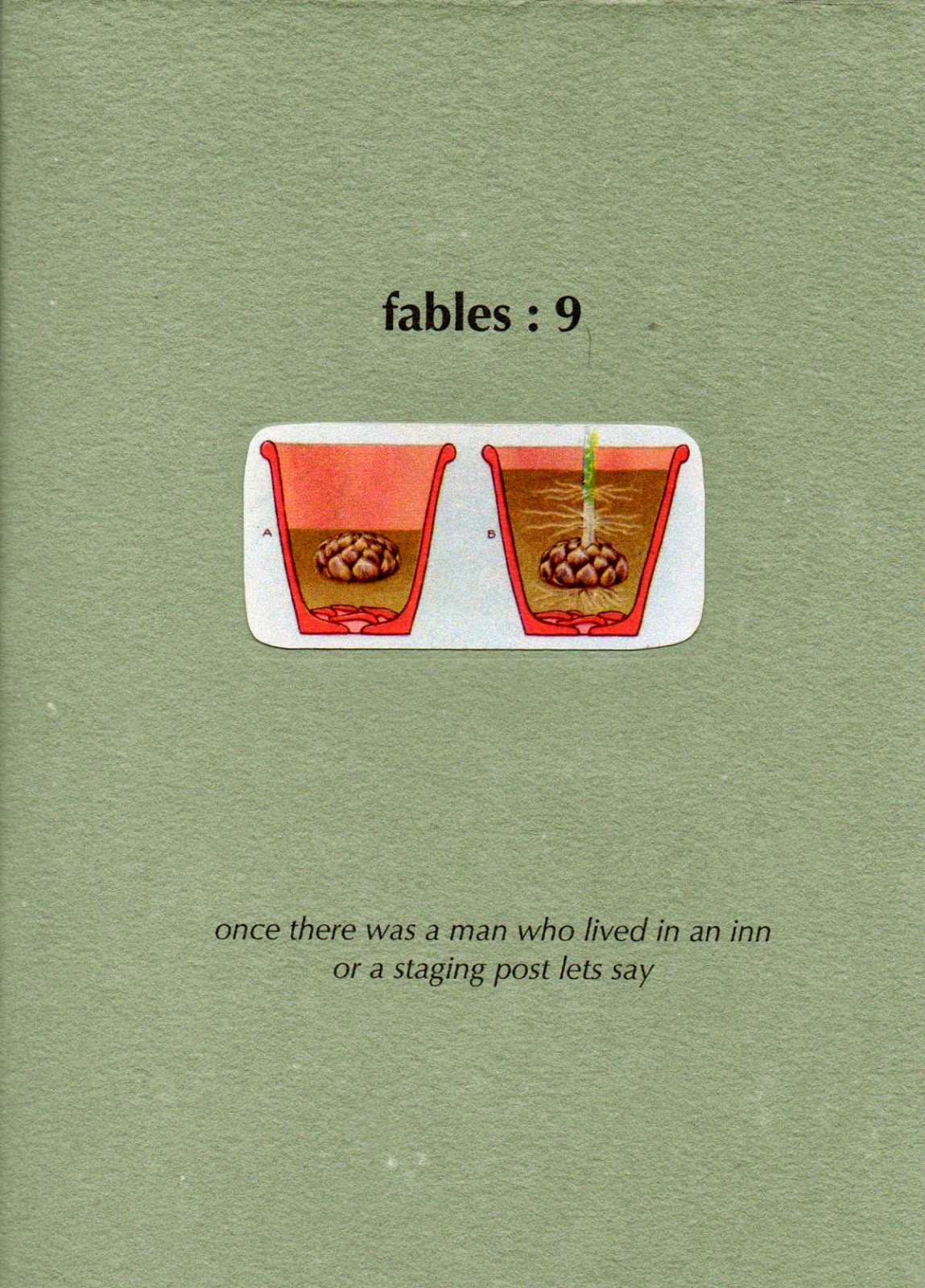
fables 9 : Ash & Ish


The latest tale from the 'fables' series. In this particular case, first the full stops went, then the commas, then the apostrophes, then all other punctuation, until nothing was left but the bare comic tale of Ash, who one day just stops in the street. As passers-by turn him into a fetish figure, draping him with the adornments of their predilections, and the authorities decide what to do with him, worrying that he constitutes a fire hazard, Ish, Ash's inside other, is left harried and frantic, rushing around trying to kick-start his engine, but to no avail. A pretty pass, all told.

writers on cylinders: Hans Henny Jahnn


The second in the series of writers on altered phonograph cylinders commemorates the German writer and organ-builder Hans Henny Jahnn, especially his dark, fantastical 1962 novella, The Night of Lead. The cylinder is lead lined and contains a snuffed-out stub of candle, whose wax has seeped through the packaging. Hidden on the cylinder are the words, 'we walk the streets until our love turns bad'. As you might imagine, the 'sacred' on the top label - left on from the original - is ironic.

Monday, 30 December 2013

40 the collier & the foss


december 2013
152mm x 190mm
sewn booklet with painted wrappers
8 pages

This tale has been concocted out of His Grandfather's Bible; A Tale of Furness Fells, a novel written by C. Wareing Bardsley, M.A., Vicar of Ulverston and excerpted in the 1885 edition of Home Words for Heart and Hearth (see also Colva Books 30: Henry Jekyll's Partial Statement of the Case, below), the version on which this current treatment is based. The words are exactly the same as those used in the original; all that has been changed is their order, so what was a pious story of redemption for a prodigal son is now something in the line of a tale of pagan sacrifice and the enduring natural force of life. The vicar would surely not have wanted it so, but his main character, the charcoal burner 'Old Antony', was so vigorously drawn - he was, we are told 'a man who never grows old' and whose face 'had dyes such as were worn by Druid priests in the days of the consecrated mistletoe and the hallowed oak' - that the theme of sacrifice and continuation was to be found not too far beneath the surface. The care that Bardsley took to preserve his characters' robust Lancashire dialect is also apparent; his words have been preserved exactly as originally penned, likewise his idiosyncratic punctuation.

Sunday, 17 November 2013

writers on cylinders: Robert Walser


The third in the phonograph series pays homage to the Swiss writer Robert Walser, whose exquisitely tortuous playfulness in prose is unmatched. For all of the loneliness and doubt behind his words, their presiding characteristic is good humour and one rarely leaves it not feeling at least a little uplifted. Rambling is a consistent theme in Walser's writing (I've given him a song title of 'How splendid to wander in the bright summer air!' - 'vocal; unaccompanied' of course). His sentences also resemble the act: characteristically they find him striding out, stumbling a little perhaps but then finding something fascinating by the wayside to take his attention; mixing extraordinary expostulation with simple-hearted delight and tremulous uncertainty, he doubles back, heads forward again, turns round and admires the view, exclaims 'how delightful all this is!' - and then ends with a question mark that puts the whole into doubt. There is no-one quite like him. There's a quote of his on the bottom of the phonograph: 'We don't need to see anything out of the ordinary. We already see so much.'