Thursday, 17 September 2015

Moulding Plane: The Plough

A second moulding plane marked with a changing pattern of stars, this time those comprising the asterism of The Plough (aka The Great Wain or Wagon, Charles's Wain, or The Big Dipper) - Dubhe, Merak, Phecda, Megrez, Alioth, Mizar (a double star with Alcor) and Alkaid. Again, the blue stars show how it looked to humans 50 millennia ago, the white stars how it looks now, and the red stars how it will look in 100 millennia.

Moulding Plane: Cassiopeia


A moulding plane marked with the changing pattern of the stars (as seen from Earth) that comprise the constellation of Cassiopeia. The blue stars show it looked from our perspective 50 millennia ago, the white stars how it looks now, and the red stars how it will look in 100 millennia, with list of the star's traditional names - Shedir, Caph, Tsih , Ruchbah and Segin - on the rear.

Monday, 14 September 2015

43 Simenon (si ou non)


August 2015
double-sewn booklet
16 pages
180mm x 214mm


The content of Simenon (Simenon si ou non) comprises the openings or endings of six novels – two Maigrets and four romans durs – by Georges Simenon. The openings have been rewritten into endings, and the endings have likewise been turned into openings. Barring a few minor changes necessitated by grammatical sense the words are identical, just re-ordered; they are paired by number throughout, raising the puzzle of which is which, with the identities of both originals and imposters revealed at the end. The booklet is sewn at both sides (this was the origin for the booklet in fact as I was looking for a subject suitable for such a treatment) with the pages interleaved. I know the French title is gramatically shaky (‘You’re not going to call it that, are you? Si!’) but that’s what it has been since the booklet’s inception; the name was too good not to make use of in such a way.

writers on phonograph cylinders cabinet


August 2015

What was once a spice cabinet is now the housing for all six of the cylinders in the 'writers on phonograph cylinders' series - Algernon Blackwood, Hans Henny Jahnn, Robert Walser, Franz Kafka, Hermann Hesse and Arthur Machen, details of which can be found throughout the blog. The bottom drawers of the cabinet are filled with fireweed silks and dried marigolds respectively, their contents the same as those found in the cylinders for Robert Walser and Hermann Hesse. There is also another cabinet I have made to house all six cylinders, reconstituted from an old oak writing slope, now repaired, shelved and felt-lined.

writers on phonograph cylinders: Arthur Machen


July 2015

This sixth and last cylinder pays homage to the Welsh writer Arthur Machen (1863-1947), author of, among others, The Inmost Light (1894), The Three Imposters (1895), Ornaments in Jade (1895), The White People (1899), The Bowmen (1914), The Great Return (1915) and The Terror (1917).

Born in Caerleon in Gwent, but living and working for the bulk of his creative life in London, Machen was a writer of the borderlands, the literal ones of the Welsh Marches to which he returned time and again in his fiction but also the liminal worlds of the uncanny as they manifest in the everyday. His was an ability, as Iain Sinclair puts it in his 2103 essay, Our Unknown Everywhere, 'to recognise holy hills behind a sprawl of suburbs'. Holy hills and shadowy strangeness; his half-hidden worlds of pungent darkness that he conjured in his works required a similar treatment, hence the cylinder is lined with an old dark pelt of uncertain provenance. Works referenced on the cylnder include The Great God Pan (1894), A Fragment of Life (1906) and The London Adventure (1924).

writers on phonograph cylinders: Hermann Hesse


May 2015

This fifth entry in the phonograph series pays homage to the German-speaking Swiss poet, novelist, and painter, Hermann Hesse (1877-1962), the author of, amongst others, Knulp (1915), Strange News from Another Star (1919), Narziss and Goldmund (1930) and The Glass Bead Game (1943). The main lettering on the cylinder has been transformed from 'Edison Blue Amberol Record' to 'Amberol Pure-Tone Record', a nod towards Hesse's key essay written in 1914, after the outbreak of the First World War, O Freunde, nicht diese Töne!, in which he decried the unthinking lurch to nationalism and called for people to remember their common European heritage. Other works referenced on the cylinder include Siddhartha (1922), Steppenwolf (1927) and Wandering (1920), with a passage from that beautiful collection's Mountain Pass ('But I smile, and not only with my mouth. I smile with my soul, with my eyes, with my whole skin, and I offer these countrysides, whose fragrances drift up to me, different senses than those I had before, more delicate, more silent, more finely honed, better practised, and more grateful…') printed on the side. As with all of the cylinders, this one contains something appropriate to the writer inside, in this case dried marigolds. As an important plant of offering, festivities and worship in both western and eastern religions, they seemed the perfect plant to pay homage to a writer who sought and promoted spiritual truth and understanding through his words.

Tuesday, 23 June 2015

six translations of The Top by Kafka: 2015 edition


June 2015
sewn booklet
20 pages
128mm x 164mm

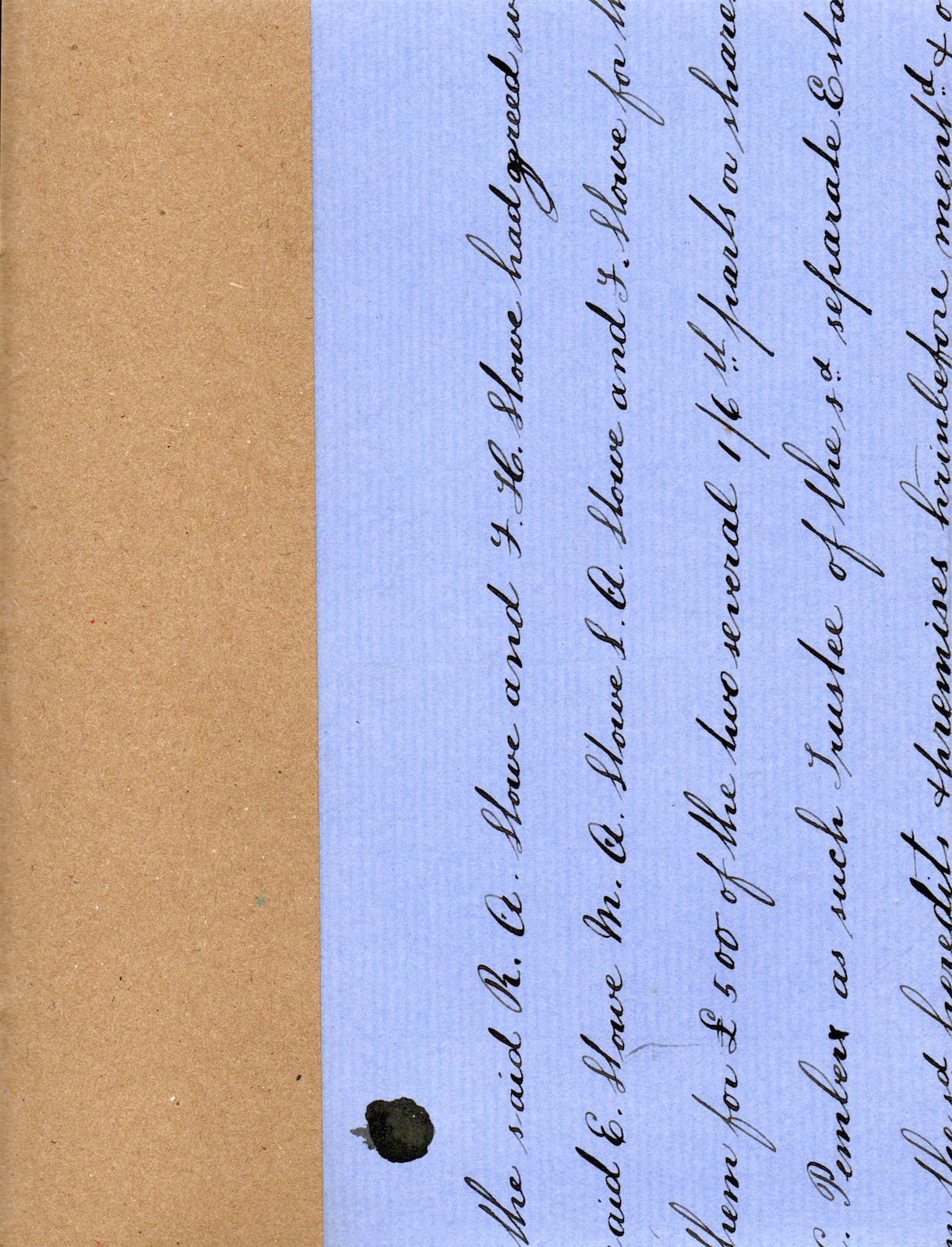
A re-set edition of a booklet that I originally wrote in 2002 - Six Translations of The Top by Kafka. The content of the booklet comprises six transliterations, in English, of an English translation of Kafka's short story, The Top (c. 1917-23). After the original story, the transliterations take, respectively, the following forms: same syllable count; a retelling through dictionary definitions; a retelling using the Oulipian standby of n+7 (replacing the story's nouns with the noun 7 words after it in a chosen dictionary); an anagram of the original; a version using the same syntax and punctuation, and lastly a version using the same syntax. The covers use the pages from some wonderful 1880s legal blue paper I found, whose lines of convoluted legalese seem just right for the content.

66 gates


March 2015
Card with CD
148mm x 148mm

I knew there were a lot of gates on the Offa's Dyke path between Kington and Knighton, my main memory of a September walk - along with finding a decent haul of both Beefsteak Fungus and Hen of the Woods, both cooked up and enjoyed in the following days - being the clanging of gates; what I didn't realise was that are 66 of them (probably more now) in the 12 1/2 miles. I walked the route again (Knighton to Kington) on 18th March this year (2015) and took my recorder with me, capturing both the opening of the gate, the pause and the subsequent clang, letting the reverberations die down until background noise took over. Listening afterwards it's interesting how the background traffic noise near Knighton gives way to skylarks in the hills above and then sounds of lambing as Kington nears. I hadn't realised either that the sound of gates - all so individual - could be quite so funny.

Wednesday, 3 June 2015

exhibition in Freshford


My cylinders and a number of bookworks appropriate to the theme of the exhibition - 'Artists who use Found Objects' - are going to be on display in Freshford, near Bath, from June 6th-June 14th (I think I come under 'Curiosities'.) Open 11-6 daily - come along if you are nearby!

Tuesday, 31 March 2015

42 three stories from the journals of Stanton Hamer


February 2015
sewn booklet with wrappers
148mm x 210mm
28 pages

A collection of three stories transposed from the travel journals of one Stanton Hamer, unearthed from a box of unsorted papers won at auction. The tales – untitled in the original but which I have named …and They Danced, Sleep and Ribbon Bows – are set in 1950s France, where Hamer evidently travelled independently for some years.

(The stories are in fact fictional, as are the journals, as, for that matter, is Stanton Hamer, but the images – which inspired the book in the first place – are real, albeit scanned at a very high resolution from the 14mm x 12mm original transparencies found on a collection of French sterescope cards.)

Wednesday, 4 March 2015

cine-series 1-12


February 2015
140mm x 120mm
sewn booklets

Having spent the best part of twelve years writing and podcasting on a diverse range of film for MovieMail, Vertigo, Artesian, Second Run, the BFI and Borderlines Film Festival, I wanted to put together a valedictory series to all that, so I have collected together a few longer pieces written during that time – some previously published in somewhat altered form, others unpublished, nearly all with an element of poetry in their appreciation – and made a small 'cine-series' of 12 booklets. The films range in date from the silent era to the 21st century and are all linked by the single fact that they have touched me deeply in some way – deeply enough for their narratives to interweave with that of my own life, either directly or obliquely. The size and cover design tips the hat to those 1960s-70s 'Studio Vista' books on directors and film movements. The twelve titles in the series are Mother and Son (Alexandr Sokurov, 1997), Into Great Silence (Philip Gröning, 2005), Love (Károly Makk, 1971), Szindbád (Zoltan Huszárik, 1971), Alice in the Cities (Wim Wenders, 1974), Rapture by Tearlight: The Silent Cinema of Frank Borzage, Shame (Ingmar Bergman, 1968), L'Argent (Marcel L'Herbier, 1928), Palms (Artur Aristakisyan, 1994), Cave of Forgotten Dreams (Werner Herzog, 2010), Patches of Prepared Darkness: Val Lewton's Cat People, and City Girl (FW Murnau, 1930). The cover image shown here is from Palms.

Tuesday, 4 November 2014

41 they would still lie plainly visible


October 2014
142mm x 208mm
sewn booklet with wrappers
24 pages

In A Book of Luminous Things: An International Anthology of Poetry (1996), editor Czeslaw Milosz included a short poem entitled The Day We Die, which he calls a song from the ‘Southern Bushmen’. The only credit – given in the ‘Permissions’ section at the back of the book – goes to Arthur Markowitz, who is named – erroneously – as the ‘translator’. All of which does its author and its real translator, without whom these words and thoughts would be entirely lost to us, a great injustice. For this is not an anonymous song. (To give an idea how inaccurate this is as a description, imagine taking the words from one small part of a chorus as it appears in one Greek tragedy from a known dramatist and calling it a ‘song of the southern European’.) We know who told it to whom, on what day and where. There are even photographs of the storyteller and his translator. The story – of which ‘The Day we Die’ is but one part and which was given the title ‘The Relations of Wind, Moon and Cloud to Human Beings after Death’ by Lucy Lloyd – was told by the !nussa !e Bushman Dia!kwain, in a |xam dialect which was transcribed by Lucy Lloyd on 5th August, 1875 in Cape Town. It appears on pages 5147-5158 in her notebook, Bushman (D.H.) Pp.5079-5168 1875 V.—15 – one of the 131 of her notebooks, containing transcriptions of stories in |xam and !kun languages, which can be seen online at the remarkable Digital Bleek and Lloyd collection. This booklet gives a brief history of the text and how it has changed since 1875, and looks at how the abridged version that appears in the anthology distorts the original and continues the history of marginalisation and worse that has been the Bushmen's lot. It also attempts to restore Dia!kwain and Lucy Lloyd’s names to their rightful place as originators of the text. The title – and the writing on the booklet’s wrapper – is taken from the third page of Lloyd’s original transcription of the story.