
Thursday, 5 September 2013
fireweed silks drift...

fables : 8

'The tea was dishonest, tasting vaguely of shrimp…' And here is another from the series, Fables 8 : Modern Times. Where is this one set? A down-at-heel encampment for low-key dissidents perhaps, engaged upon their work of tidying up anomalies in official pronouncements, where jocular camarderie is not quite enough to still the slivers of threat that poke through the cracks: 'bring me the silver of your stream, says the knife grinder, bring me its golden light.' It ends - as a number of my stories seem to these days - with thistledown upon the air. The rather lovely pea green wrappers are made from Ruscombe Mill's Forest Green Wove 180gsm paper.
fables : 6

I have printed up a number of stories, written between 2006 and the present day and linked through their singular method of composition, as a series of 'fables'. Here is number 6 - The Walk. My usual ambivalence to titles is plain as the words don't actually appear on the cover, which instead spreads the load between the series, an image - taken, as all the rest in the run, from Wills's 1923 set of Gardening Hints - and the first line of the tale. As for the story, it's a walk of sorts, engaged upon by a man of less than moderate means and fewer prospects, that commences with the promise of springtime hemlines and ends in the middle of his outing, between his destination and his desk. And I rather like the 'Gardening Hints' card I used for the cover, on two ways of staking runner beans. Thus far, I have always gone for the more traditional method of 'A', but can see the benefits of 'B' - a sort of hop twine arrangement to which I shall give serious consideration next year.
writers on cylinders: Algernon Blackwood
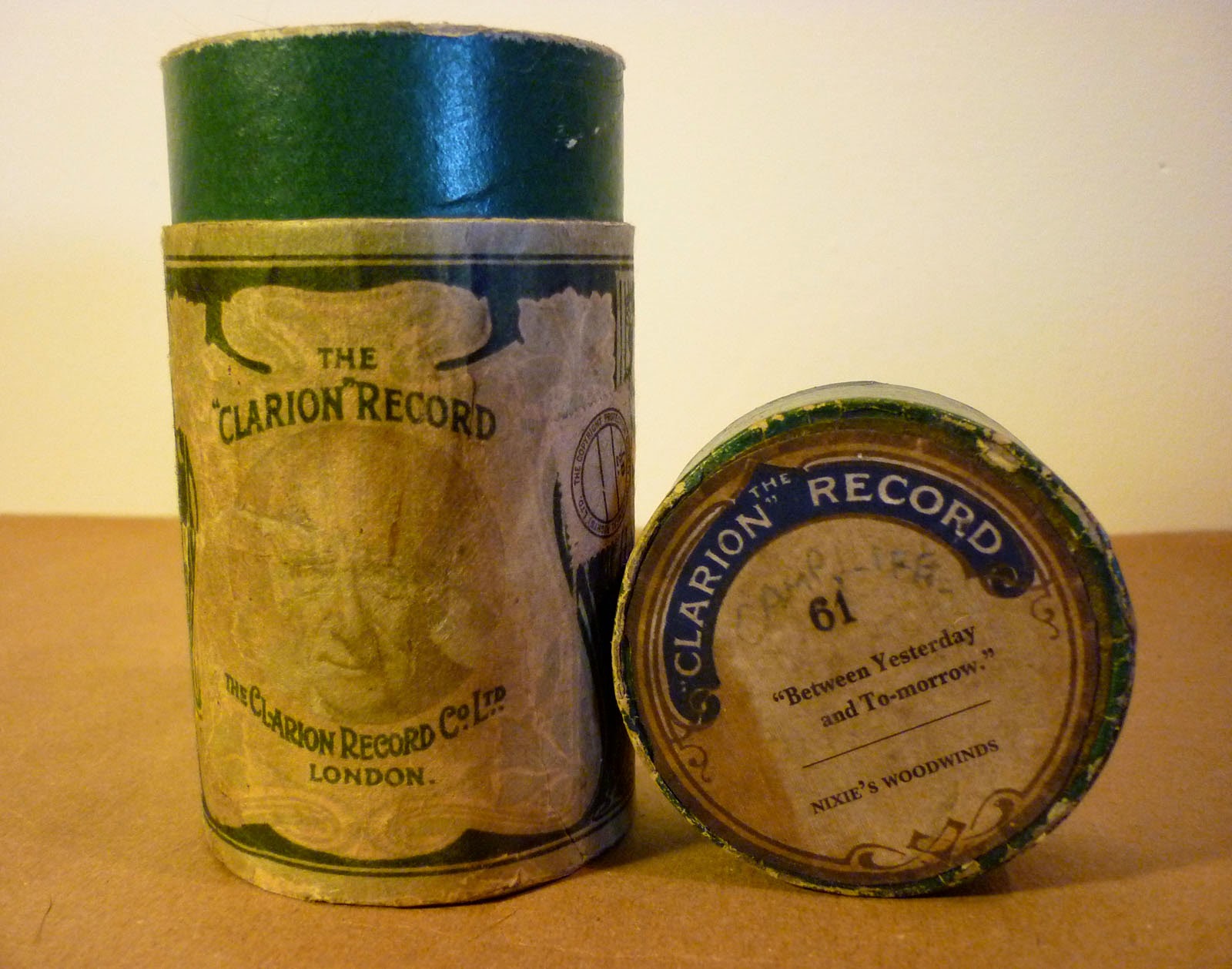
The first in a series of homages to various writers, as encapsulated by altered phonograph cylinder packaging. Algernon Blackwood is a rather overlooked writer these days, whose real subject - despite numerous lurid book jackets trying to persuade us otherwise - is wonder; dreadful wonder at times maybe, but wonder nevertheless, most often of that magical childlike quality that makes the unlikeliest of connections between things which adults seek to reason away. But the children know best. The Blackwood cylinder uses elements of his books The Education of Uncle Paul (1909), The Human Chord (1910) and The Promise of Air (1918). The song title - 'Between Yesterday and To-morrow' - is credited to 'Nixie's Woodwinds' (Nixie's vision in The Education of Uncle Paul of the dawning and unfurling of the winds is still extraordinary), and the cylinder is filled with feather down. The top cylinder label actually had the word 'Camplife' written on it by someone in the past; reading about Blackwood's experiences in the Canadian wilderness among other places, it seemed an eminently fitting word to leave in place.
Friday, 19 April 2013
Volume 14: Libido to Mary, Duchess of Burgundy

After all attempts by their original owner to find them a new home failed, the Sidney Nolan Trust was given a set of 1950s Encyclopædia Britannica so that they could turn them into new artworks, all of which can currently be seen (until 6 May 2013) in The Old Foundry Studio & Gallery at Bewdley Museum. I found my way to Volume 14 of the set: Libido to Mary, Duchess of Burgundy. Reading through it I felt smothered by the accumulated dust of knowledge and did a few approximate word counts. They were surprising. Topping the list in the volume were 43,000 words on Logic and Logical Positivism and 38,000 words on Libraries. The entry on Man only merited 16,000 words, while Life Insurance had 8,000 and Lycanthropy over 2,000. Even Lumbago had 175 words. And Love? Not a single word. Not even an entry. I eviscerated the volume and put a few mementos and part of a letter written by a person who can continue what they are doing through the love of another. I found the following definition of ‘Encyclopædia’, from The Encyclopædia Da Costa, helpful: ‘Encyclopædias trouble themselves a great deal about words fallen into disuse, never about words still unknown, burning to be uttered.’
Wednesday, 19 December 2012
Offbeat: British Cinema's Curiosities, Obscurities and Forgotten Gems

A post to mark the publication of Julian Upton's Offbeat: British Cinema's Curiosities, Obscurities and Forgotten Gems, which was initially available in a limited edition no-ISBN hardback from Headpress, and is now out in widely available paperback. For anyone interested in the backwaters and byways of British cinema it's highly recommended, not least for Julian's pithily precise and often extremely funny writing. I penned a few extended reviews for it a while ago now - on the films X the Unknown (Leslie Norman, 1956), The Day the Earth Caught Fire (Val Guest, 1961), The Earth Dies Screaming (Terence Fisher, 1964), Herostratus (Don Levy, 1967), Privilege (Peter Watkins, 1967) and No Blade of Grass (Cornel Wilde, 1970). Here's a still of Edward Chapman, William Lucas, Leo McKern and Dean Jagger in one of the films I write about, Hammer's X the Unknown.
Sunday, 26 August 2012
35 the thing is...

july 2012
128mm x 96mm
24 interleaved pages
hand-sewn in Saint-Armand rag paper wrapper
More often than not, what follows the words is anything but, which was the starting point for these twelve short poems (mainly about about the continual flux of weather and land, if anything could be less certain) which take the phrase as their preface. Their emphatic openings are then shaded and contradicted, their initial resolve dissipated. Then all twelve poems are recombined, providing new landscapes that are equally as rich and often as plausible. The booklet is sewn at both sides, the interleaved pages hinting at the possibilities of further recombination.
Thursday, 16 August 2012
32 bestiary

june 2012
132mm x 158mm
hand-sewn booklet or pouch with cards
14 pages
A collection of biographical excerpts inspired by a number of rusting tools found in my shed and a number of cleaned-up tools borrowed from Bernard's odds-and-ends shop in Kington. Subjects range far and wide, from Matsuo Bashō to Somerset Maugham, Hugo Ball to Sir Martin Frobisher and Jacques Tati to Niall MacGinnis (among others). Some of the writing might even be true, but hopefully not the bits you might expect. It comes in two forms: a flapped pouch of separate cards which shows the images of the tools to good effect but was, frankly, laborious to cut and fold, and, hence, also a simpler sewn booklet that features smaller images printed on its wrapper.
Monday, 11 June 2012
34 'ours was an age of certainties...'

may 2012
85mm x 140mm
hand-sewn booklet with tree bark paper wrapper
10 pages
edition of 10
An anonymous, broken narrative from a displaced time (or vice versa), printed on the blank rear pages of illustrations from a discarded, foxed book, with the words pouched up into a clandestine form inspired by a 'housewife' pocket sewing kit. The wrapper is made from Amate tree bark paper. The book is one of 45 artist's books in a travelling book art exhibition, arranged as a collaboration between The Sidney Nolan Trust, The University of the West of England in Bristol and Warringah Studios in Sydney, Australia. For ease of transportation between venues, the maximum dimensions of the book could be no more than 14cm x 8.5cm. The first two stops on their tour are UWE from 2 July-31 August and then The Rodd (near Presteigne) between 7-16 September, as part of the h.Art exibition there.
Monday, 16 April 2012
colva's aeronautical centenary
 100 years ago this coming weekend, in April 1912, four days after the RMS Titanic hit an iceberg and three days after Harriet Quimby became the first woman to cross the English Channel by aeroplane, Denys Corbett Wilson - courtesy first of a buffeting wind that caused him to drop his compass overboard, necessitating a night's stay in Almeley, near Hereford, and second of taking advantage of this unscheduled stop to do some maintenance on his engine, filling it when he did so with the wrong grade of castor oil - found himself about half an hour into his flight from Almeley with a badly misfiring engine and in pressing need of a flat spot to make an emergency landing. Unfortunately, at that moment he was flying over the hills of Radnorshire where flat spots are a rarity, but nevertheless managed to touch down in a reasonably level field ('the only level bit of ground for miles, only 120 yards long and about 40 wide') in the remote hamlet of Colva, where the plane stayed for three days, awaiting Corbett Wilson's French engineer, Gaston Vial, to arrive and get it back into flying order. If Corbett Wilson had appeared in the Les aviateurs du monde series of postcards that were produced around this time, this - Corbett Wilson taking off from Colva just after dawn on the 21st, watched by the hundreds of onlookers who had come from far and wide before dawn to see this amazing sight - is what it might have looked like.
Friday, 13 April 2012
30 henry jekyll's partial statement of the case
 april 2012
112mm x 194mm
hand-sewn booklet with wrappers
14 pages
Henry Jekyll's Full Statement of the Case, chapter 10 of Robert Louis Stevenson's Strange Case of Dr. Jekyll and Mr. Hyde, is here divided, re-aligned, cropped and re-presented as a fractured and jittery account of his hubristic adventure that nevertheless – thanks entirely to Stevenson's clear and pungent phrasing – still clearly transmits his horrific journey into an irreparably parted self. Aligned to left and right but gapped between, the account is printed as two columns to be read across, though a reading down the columns is also possible. The rather sinister character on the cover of the booklet I found in Home Words for Heart and Hearth – a pious book dating from the same year that Robert Louis Stevenson wrote Strange Case of Dr. Jekyll and Mr. Hyde (1885), filled with prayers, moralising stories and sermons and, best of all, engravings of various church worthies of the day. And a seedy-looking bunch they are too. There was some stiff competition for the cover, but in the end it was Dr. Jackson, the Late Bishop of London, who won out.
Thursday, 12 April 2012
33 disuse is bad for the machine

january 2012
hand-sewn booklet
124mm x 164mm
10 pages
The nine commandments laid down for the correct usage of 'His Master's Voice' products on a 1920s 78rpm record sleeve, among them: 'Don't wind spring too tightly'; 'Don't interfere with regulator unless an adjustment is necessary'; 'Avoid the slightest injury to the Mica Diaphragm', and – gnomically if now inscrutably – 'Keep leathers which operate on governor friction plate well oiled', have a hectoring quality which stems from the manner of their listing, beginning with Rule Number 1: 'Disuse is bad for the machine'. To me, this implied a proto-Orwellian world (though in time and vision it comes closer to the Moloch Machine and its ceaselessly gaping maw in Fritz Lang's Metropolis), with the suggestion of people as slaves to the requirements of machinery finding ready parallels in our own time. The short texts within, taking their cue from the 'His Master's Voice' commandments, are leashed neither to time nor place, making the writing hard to pin down, though its tone is characterised by a mournful, impotent regret at possibilities lost. The booklet is thin and deliberately cheap-looking, implying scarcity of resources in tawdry, mass-produced times.
Subscribe to:
Posts (Atom)
